Showing posts with label Nazareth. Show all posts

Wednesday, August 14, 2013

A TOUCH OF SCOTLAND IN NAZARETH

It is a while since I followed up on my write-up of our trip to Nazareth.  We visited more than once, however, the first time was with a guided day tour and very good it was too.  See here for the first post  http://myword1.blogspot.co.uk/2013/02/a-visit-to-nazareth.html  When  we went independently, we felt rather disorientated at first.  http://myword1.blogspot.co.uk/2013/03/the-next-trip-to-nazareth.html The tourist office wasn't where we thought it was. We found it  on our way back to the bus, at the end of the day.

We revisited a number of the places we had seen previously in the centre of Nazareth and were surprised at how close they were to one another. For example, The Church Of The Annunciation, the ancient town of Nazareth and the Basilica.  The Basilica visit will be another post.

Exploring the ancient quarter we found the Al Mutran Guest House.  It has good reports.  We were allowed to look inside the reception area  styled like the old Middle East. Aladdin would have loved the old lamps and carpet wall hangings. Everything was sparkling.


The parked cars kept you in touch with the here and now in a very old place where you felt history literally under your feet. A dig down, not too far, would, I am sure, have unearthed many archaeological fascinations.


On our way to the old market we saw a lovely old quarter we had not visited before,  where we found The 18th Century Saraya.  'Saraya' is Turkish for Castle or Palace.  This was an Ottoman governor's  residence and administrative centre. As I read the information plaque I received an urgent summons from hubby.  Almost next door was a cafe which was housed in what used to be the  Governor's wife's quarters, according to Abu Ashraf.  He  had ran the cafe there for more than 33 years and knew its history well.  When I arrived, I was utterly amazed to see Scottish Griddle pancakes  being made. "No," he insisted, "Not Scottish, these are my own recipe.  I created it".  While a man sitting nearby argued "Yes, Scottish".   

He had visited Glasgow once for two days,  had seen griddle pancakes and eaten some during his brief visit.  The cafe was closed till the day's stock of pancakes had been made.  It  usually opened about midday.
 Abu, a very educated man and very interesting to talk to, is seen here making his pancakes for the day and allowing them to cool on the sales table.  That's quite a pile and a lot more were added to it.
Abu asked us to try his finished product and invited us into the cafe to sit  and enjoy what he was about to create.  What we were seeing were the 'ready made' bases sold to customers to finish at home in their own style; what we were about to receive was a treat that Abu Ashraf has become well known for in his corner of the world and also, farther afield.  He is a speciality celebrity chef of Kataifi, though we did not know it at the time. This link will tell you more -  http://www.letsgo.com/middle-east/israel/nazareth/food/diwan-al-saraya

This is the treat Abu produced especially for us. It is a wonderful absolutely delicious memory.  While the base is a recognisable Scottish griddle pancake, the finished dish is definitely not.
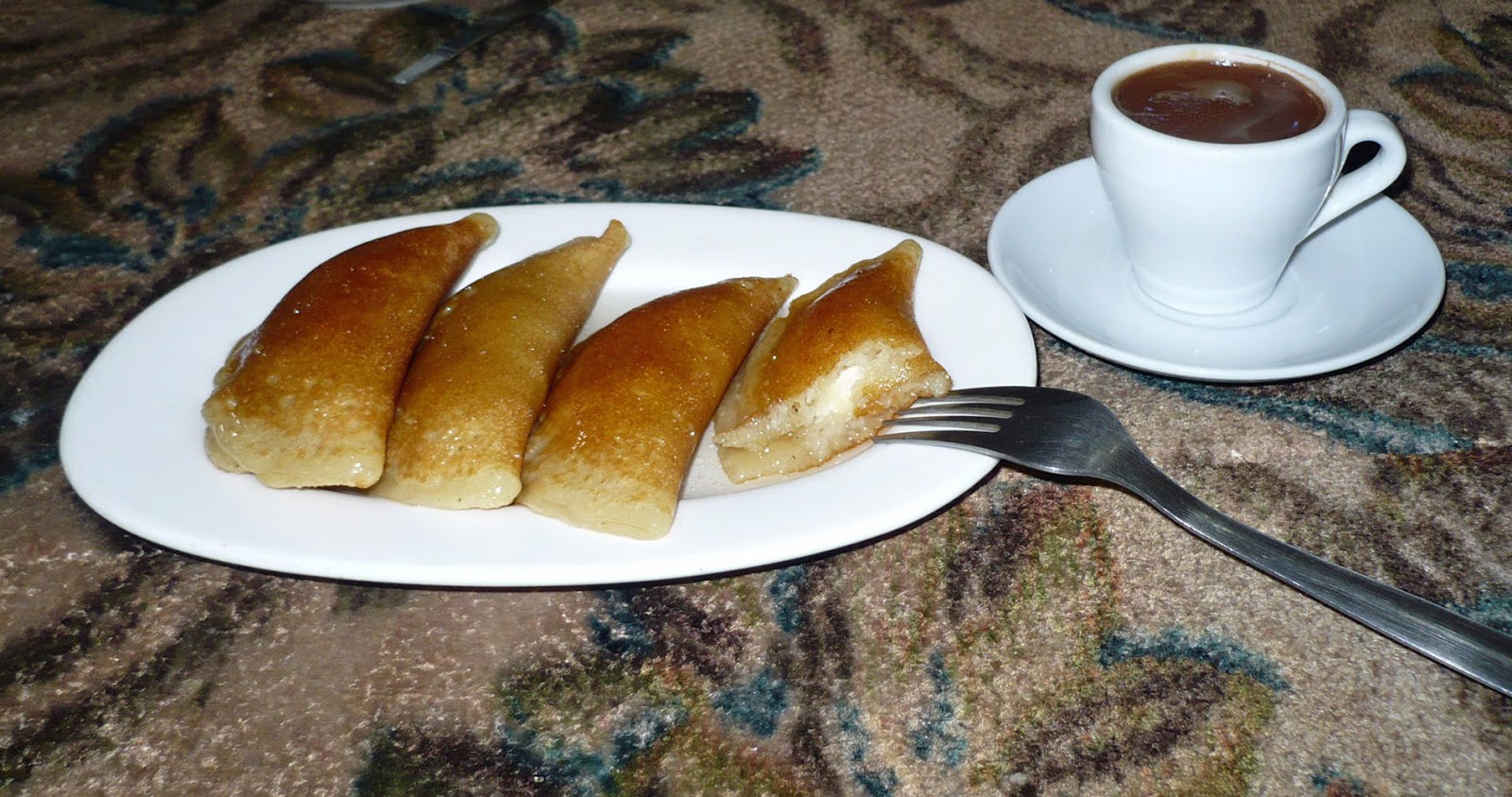
 You see the cup of Oriental coffee, that one was hubby's.

This is how the cup looked once he had finished his drink. I promise you, this is genuine. This is exactly how the coffee grouts formed.  I just had to get a picture of it. The coffee grouts in my cup were totally uninspiring.

If you follow the 'letsgo.com' link given above, there is a reference  to Abu Ashraf's collection of stoves and memorabilia of many kinds, in the cafe.  Here's some pictures we took that give you a feel for it.


 There was quite a museum collection, far more than is shown in these pictures.  If ever there was a power failure at the cafe, Abu would have sufficient alternative equipment to work with.  The primus stoves would have stood the cooking test.

Here is a real mix of 'bric-a-brac' crossing  faiths, culinary tools and storage containers. You could even boil a kettle or two on the stoves.


A decorative samovar, ibriks and candle sticks living side by side on this shelf. The duck is cute.

In the winter when business was quiet, Abu said he spent time on as many of the artifacts he could get round to.

The old market of Nazareth was easy to wander around, (unlike the old Jerusalem market).  Hubby was in search of a Wonderpot. They seemed to be available in every kitchen appliance market booth.  Here's one in use.

Friday, March 29, 2013

THE NEXT TRIP TO NAZARETH

The next trip to the Galilee was under our own steam, so-to-speak. (Last visit we went on a  day tour with a brilliant  guide).   Using the intercity buses, we based ourselves at Tiberius (Tiveria).  We were high on a hill, which, if our hotel window had been less obstructed, we would have been overlooking the Sea of Galilee.  As it was, it still being winter, cold and damp for them, (not so cold for us Northern European visitors), there was also a mist that regularly obscured the outlook too.  If you peer into the left of the picture you will just about see the sea, locally known as Lake Kineret.


Misty view of The Sea of Galilee over rooftops -click to enlarge
It's always easy to walk downhill, so about fifteen minutes after we arrived, we found ourselves in the hustle and bustle of the international hotel area, a market with food stalls that came to life at night, and not far away, the central bus station to everywhere. The tourist information office, also in the centre, had closed for the day.

Fortunately, there was an intercity bus stop in the side street close to the hotel, otherwise it would have been a bit of a trek to connect with transport. The hotel receptionist we met, was an information lifesaver; being a Nazarene, he was really pleased we wanted to visit where he lived, "not far away," he said "Somebody will tell you".  It was soon clear to us that independent international travellers would fare better being in town, that the hotels on the periphery were business orientated and just not geared up to provide for independent  tourists. We received print-outs of bus times, (those we required were underlined with the receptionist's pen) and we were given a double-sided map, both in Ivrit, (Hebrew) and Arabic.  Armed with these papers, and feeling totally disempowered, we went to investigate the bus stop.

I reckoned if I could say the name of the name of  the place as it was known locally, we stood a better chance of getting on the right bus and arriving there. The driver beckoned us in, a fare was paid and we took our seats.  "You want to go to the centre of Nazareth?" asked a woman in English. She had to get off the bus before us, however, she explained to the driver exactly where he should tell us to alight. Wow!  In a street crowded with people and jam-packed with cars, which were virtually at a standstill, the driver signalled to us we were near our stop.  He pointed emphatically at a row of bus stops to indicate where we should return to for the bus back to Tiberius.

In Nazareth, with nobody to guide us, we were a bit disorientated.  On the list of  'must see' places, were the ruins beneath the Basilica; to explore the ancient quarter of Nazareth and also the market.  The first sight to greet us were these billboards, (what else might you call them).  We studied them with interest.


To the right of the picture you can see the thick grey 'spire' of The Basilica


click pictures to enlarge


To be continued/......


Tuesday, February 19, 2013

A JOURNEY TO NAZARETH

Our first visit to Nazareth was with a small group led by an incredibly knowledgeable guide.  We were the first passengers to be picked up in a mini bus from our hotel in Haifa on that Saturday. The trip was advertised  in the Haifa Tourist Office as a tour to the Christian sites.  It was "A really lovely and interesting tour," we were told.  There were six people in the group, a nice number, including a portly couple from Argentina.

The intention was to tell us how to read icons at the first church, The Church of the Annunciation. The icons, though, had all been removed for renovation.  Instead we wandered round the compact building and before we left, were introduced to spotless public toilets.  The young Serbian Girl, who was paired up with an Israeli boy, made her obeisances on arrival and departure, while he looked on respectfully.


Church Of The Annunciation 


 We all piled back into the bus, some more agile than others and headed off for the ancient market at Nazareth.  From the back seat came a loud questioning whine, "When are we stopping off for lunch?" The guide politely answered, not that anyone knew the location she mentioned.


The roads were really busy, this being a mainly Arab area and a day of business. It was less busy on a Saturday - the Jewish Sabbath - than it would be on any other day of the week.  Traffic was usually at a standstill, at least we were moving, even if slowly.   At the next traffic jam, we got off the bus and headed on foot for the ancient entrance to the Nazarene market.


Here, in the alley, were ancient features to be pointed out.  The souk (shouk) was smaller than its sister market in Jerusalem, it was very manageable, a lot quieter, mostly frequented by local shoppers.  We were whisked through, at the same time I was keeping my eyes open for a reel of thread and sewing needles. Traders looked at us curiously, what did we look like, I wondered. There weren't any other visiting groups. 

We then headed for The Basilica, a predominating structure on a hill.  The Argentinian couple said they did not want to see more churches, they had enough at home.  They made themselves comfortable in the courtyard, while we went off with the guide to look at the tiled pictures around the courtyard, depicting cultural aspects of the international Roman Catholic communities who had donated to the building of the Basilica.  From us, she learned about St Andrew and his cross, both of which, featured in the Glasgow tiled picture. The magnificent Basilica doors, (see one below) told the religious story. We were then left to explore the Basilica and surrounds.  Some people entered.  I could not be bothered to queue to see through the bars of a gate, what might have been Mary's home.
 I was much more excited by the ancient, (B.C.E) streets to be seen, excavated at the time the Basilica was constructed. It stands on stilts, thereby giving a very clear view of the outline of ancient houses and roads, also, the domestic implements which lie there. As well, there are Byzantine tiled walls.  Mary's well was round the corner.  It is said she would have drawn water from it. One side looked presentable, the other was not, and had distinct pong of a urinal...pity.


Back on the bus came the recognisable questioning whine, "When are we stopping off for lunch?"  Our next stop, (which the Argentinian couple bowed out of, preferring to sit on the bus)  was the ancient Benedictine Monastery of Tabgha,  I hesitated on the threshold.   It had a  Byzantine mosaic floor, which went back to the 4th Century C.E. (A.D.)  "Go on" said the guide, " Walk on it,that's what it was made for."  Silly me, of course it was. The Alabaster windows were stunning, backlit with bright sunlight.


Alabaster Window-Chapel- Tabgha


We travelled onto Capernaum, not far away. We were not disappointed, "When are we stopping for lunch?" We heard.   The couple wished to remain on the bus, the driver, therefore, was invited to join us for this visit, as there were spare entry tickets and he could use up one.

I'll tell you about Capernaum which was yet another wonder, in another post.  Suffice to say that after this stop we went to a rest and refreshment stop, where the hungry couple ate to their hearts' content.